
What Wedding Dress for a Mauritius Wedding? The Complete Guide
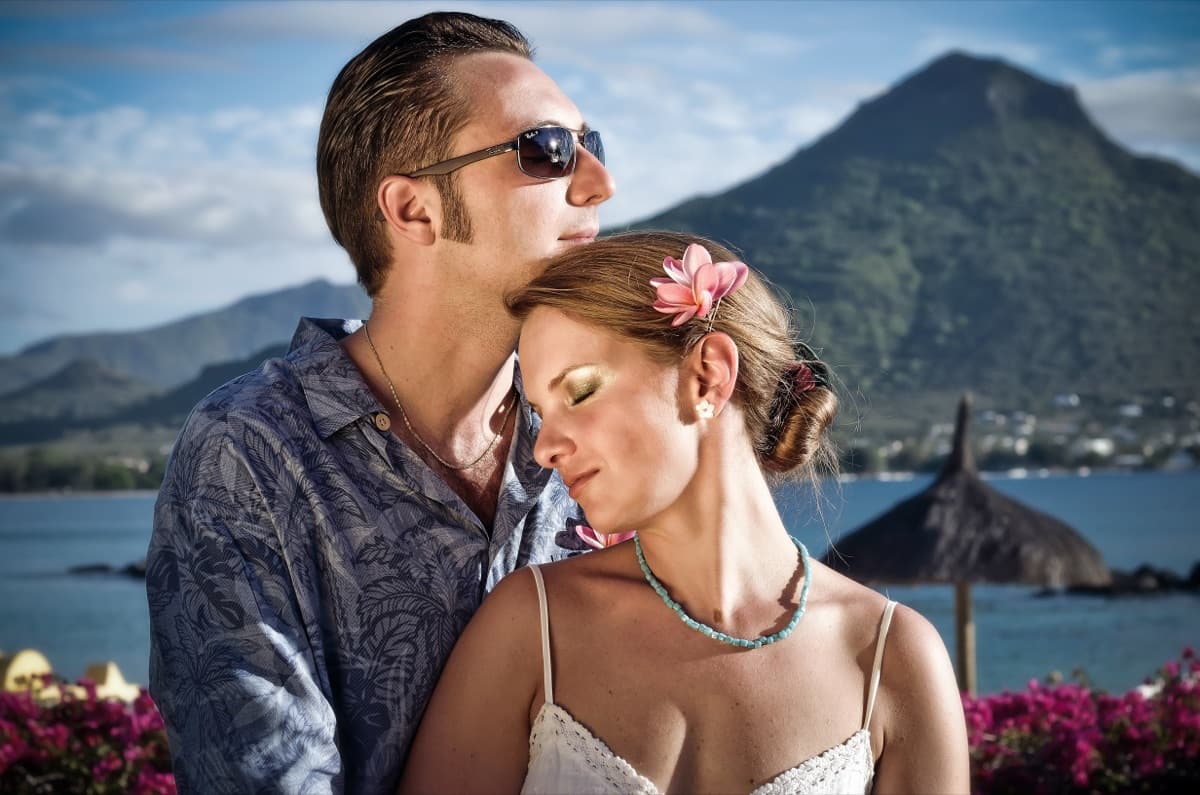
What Wedding Dress for a Mauritius Wedding? The Complete Guide
What your Parisian couturier will not tell you
Your Dream Dress and the Climate of Reality
You saw it. Maybe in a magazine, maybe in a shop window on the Avenue Montaigne, maybe on a screen at two in the morning when sleep would not come and Pinterest was keeping you company. This dress. The one that made you hold your breath. The one that sparked that involuntary smile, the one that comes from the gut, the one that says "this is the one."
And then you chose Mauritius.
And nobody — not your couturier, not your mother, not your maid of honour, not the showroom salesperson who assured you that a three-metre train was "totally manageable" — nobody told you what sixteen years of tropical wedding photography have taught us.
A wedding dress in Mauritius does not follow the same rules as a wedding dress in Paris. The climate rewrites the brief. And if you do not know this beforehand, you will discover it afterwards — in the mirror of your hotel room, at thirty-two degrees with eighty per cent humidity, and that sudden realisation that tulle, when it clings to your skin, no longer looks anything like a cloud.
This guide exists to spare you that late discovery. And to promise you something else: the dress you will wear in Mauritius may be different from the one you imagined, but it will be more beautiful. Because a dress that breathes, that moves with the wind, that dances with the tropical light — that dress is incomparably more photogenic than the most sumptuous construction of motionless tulle.
The Fabrics: What Works, What Suffers
This is the first conversation to have — and the most important.
The allies of a tropical climate
Silk chiffon. It is, by far, the most successful fabric we see in Mauritius. Light, fluid, transparent just enough, it catches the slightest breeze and creates a perpetual movement that gives photographs an almost cinematic quality. Silk chiffon does not cling to the skin. It floats. And when the late afternoon breeze lifts it, it creates those iconic tropical bride images that everyone has in their mind without knowing which fabric makes them possible.
Crepe de chine. Fluid, matte, elegant. It falls along the body with a natural grace and holds up well to the heat. Less ethereal than chiffon but more structured, it suits brides who prefer a clean, contemporary silhouette.
Linen. For brides who want a bohemian and relaxed look, linen is perfect in the tropics. It wrinkles — that is inevitable and that is its nature — but in Mauritius, that crumple is part of the charm. Slightly creased linen on a barefoot bride in the sand tells a story of authenticity that the smoothest satin could never whisper.
Light lace. Chantilly lace, fine guipure, cotton lace — they work beautifully in Mauritius, provided they are lined with a breathable fabric. Lace lets the air through, creates shadow play on the skin, and photographs divinely in tropical light. Simply avoid thick, synthetic laces that trap the heat.
The enemies of a tropical climate
Tulle in industrial quantities. Princess gowns with metres of layered tulle are magnificent in an air-conditioned cathedral. In Mauritius, they become a heat trap. Synthetic tulle does not breathe, does not move with the wind (it is too rigid), and creates volume that traps hot air around the body. If you love tulle, opt for one or two light layers, not ten.
Heavy satin. Duchess satin, that shiny structured fabric that makes Hollywood ball gowns, is your worst enemy in the tropics. It does not breathe, it clings to the skin from the first drop of perspiration, and it photographs harshly in direct sunlight — the shiny reflections become overexposed white patches on the images.
Cheap synthetic fabrics. Polyester, nylon, artificial "silks" — they mimic the appearance of fine fabrics but not their behaviour. In the heat, they become cocoons of perspiration. Invest in natural or semi-natural fibres — your body and your photos will thank you.
The Cut: What the Wind Demands
In Mauritius, there is an uninvited guest who imposes itself at every outdoor ceremony: the wind.
It is unpredictable, sometimes gentle as a whisper, sometimes insistent like an overenthusiastic guest. And it radically changes the rules of the clothing game.
Cuts that dance with the wind
The empire waist. High waist just under the bust, a flowing skirt that falls freely. The wind takes it and turns it into a sail, a wing, a perpetual movement. This is the most photographed and most successful cut we see in Mauritius, season after season.
The bohemian dress. Long sleeves in sheer lace, bare or semi-open back, a flared skirt — this relaxed silhouette was born for outdoor weddings. It allows complete freedom of movement, handles the wind without losing its shape, and gives that "effortless" look that is in reality the pinnacle of elegance.
The fluid sheath dress. Close to the body but not tight-fitting, in crepe or chiffon, it follows the silhouette while letting the skin breathe. The wind presses it against you and lifts it in turn, creating a living play of fabric.
Cuts that fight the wind
The strapless bustier. The sworn enemy of the wind. Every gust becomes a source of anxiety — will it stay up? — and that anxiety shows in the photos. If you love the bustier, opt for a version with transparent straps or a corset structured enough to withstand the test of the sea breeze.
The very fitted mermaid dress. Beautiful indoors, but on sand it poses a practical problem: walking through soft sand in a mermaid dress is a tightrope walker's exercise. Freedom of movement is limited, shoes are impossible to keep on, and the hem collects everything in its path.
The Train: The Eternal Question
Let us be direct. Sand and trains are not friends.
A short train (under one metre) can work in Mauritius — it creates beautiful movement as you walk and the few grains of sand that cling to it add to the natural charm. A medium train can be managed with a buttoning system or a hook that allows you to lift it for walking on the beach and deploy it for photos.
A three-metre cathedral train on a sandy beach is a logistical nightmare. The fabric picks up sand, becomes heavy, pulls on the shoulders, and turns every step into a struggle. Unless you have two bridesmaids dedicated to train-bearing for the entire ceremony, we do not recommend this option for an outdoor wedding in Mauritius.
The alternative that works best? The two-in-one dress. A long, flowing version for the ceremony on a terrace or hard surface, and a shorter or hitched version for the beach and photos. Several couturiers offer detachable skirt systems that allow this transformation in seconds.
Transporting Your Dress to Mauritius
Your dress has been chosen, tried, altered, photographed from every angle in the mirror of the boutique. Now it has to travel eleven thousand kilometres.
In the cabin, always
Absolute rule: your dress travels in the cabin with you. Never in the hold. Never. The holds are not pressurised in the same way, temperatures fluctuate, and luggage is handled with limited tenderness. A dress crushed between two rolling suitcases for eleven hours of flight is a dress that arrives wrinkled at best, damaged at worst.
Contact your airline before flying. Air France and Air Mauritius generally accept wedding dress garment bags in the cabin — often stored in a garment compartment or in the first-class closet if space is available.
Some airlines require advance notification. Better to call than to assume.
The rigid garment bag
Invest in a rigid or semi-rigid transport bag. Not the thin plastic bag from the boutique — a proper padded bag, with sturdy handles and a secure zip.
This is an investment of fifty to a hundred euros that protects an investment a hundred times greater.
On-site alterations
Plan for the possibility of last-minute alterations in Mauritius. Despite all precautions, an eleven-hour journey can create creases or adjustments that are needed. Your wedding planner or hotel can recommend a local seamstress capable of pressing, adjusting, or repairing with skill and speed. Mauritian seamstresses are accustomed to bridal emergencies — they see them every week.
The Colour: Beyond White
White is magnificent in Mauritius. The tropical light makes it luminous without burning it, and the contrast with the golden sand and blue ocean is striking.
But white is not the only option — and in the tropics, certain shades can be even more flattering.
Ivory and champagne warm up tans deepened by the Mauritian sun and create a softer contrast with the surroundings. In photographs, these tones look natural and elegant, as if the dress were part of the landscape.
Blush (pale pink) has a natural affinity with Mauritius sunset light. At golden hour, a light blush captures the pink tones of the sky and creates a chromatic harmony that pure white cannot offer.
Discreet floral patterns — for the boldest brides — tell a tropical story without overdoing it. Subtle flower embroidery on white chiffon visually ties the dress to the island in an elegant way.
What We Have Learned Photographing a Thousand Dresses
Under the Tropics
Here is the truth that Parisian couturiers cannot tell you, because they have never seen it.
The most beautiful dresses on our photographs are almost never the most expensive. They are the freest. The ones that move. The ones that breathe. The ones that say yes to the wind instead of fighting it.
The ones that have enough fluidity to tell a story in every frame — a movement frozen, a flight captured, a dance between fabric and air.
The perfect dress for Mauritius is the one in which you can walk on the sand without stumbling. Dance without suffocating. Laugh without fearing something will tear. Kiss without calculating the angle of your train.
It is a dress in which you are yourself — more beautiful, more luminous, more free.
And when that dress meets the Mauritian light, when the wind lifts it at the exact moment you turn your head towards the person you love — that moment, that image, will be the most beautiful we capture of your entire day.
We know it. We have seen it a thousand times. And a thousand times, that moment has taken our breath away.
Nat & Jude have been photographing brides in Mauritius for over sixteen years — in white, in ivory, in blush, barefoot and with their hair in the wind. Contact us to talk about your dress, your dream, and the light that awaits you.
Related Services
Honeymoon Photo Session
Immortalize your honeymoon with a romantic photo session on the most beautiful beaches of Mauritius
Wedding Photography
Capture every precious moment of your wedding with our expertise of over 16 years
Couple Photo Session
A romantic photo session to celebrate your love in paradisiacal settings