
Getting Legally Married in Mauritius as a French Couple: Every Step, Clearly Explained
Getting Legally Married in Mauritius as a French Couple: Every Step, Clearly Explained
Love knows no borders. The bureaucracy does.
There is this moment, somewhere between the dream and the decision, where everything tips. You have said yes — not yet in front of the civil registrar, but in your heart. Mauritius will be the setting for your story. The sand, the light, the Indian Ocean as a silent witness to your vows. And then, a reality intrudes upon the dream: the paperwork.
We see it every year, in the more than sixteen years we have been photographing weddings on this island. The moment when the wonder in a couple's eyes gives way to a slight worry. "Will our marriage be recognised in France?" "What documents do we need?" "How long does it take?"
Breathe. This guide exists precisely to turn that worry into peace of mind. We have accompanied hundreds of French couples through this process, and we can promise you one thing: it is simpler than you think — provided you know exactly what to do, and when.
The First Question: Legal Ceremony or Symbolic Ceremony?
Before gathering a single document, there is a fundamental decision to make. And curiously, it is the one people talk about least.
A legal marriage in Mauritius is a real marriage. Legal. Recognised. Celebrated by a Mauritian civil registrar, registered with the local authorities, then transcribed onto French civil status records. When you return to France, you are married in the eyes of the law — everywhere in the world, since Mauritius is a member of the Hague Convention.
A symbolic ceremony has no legal value. It is a free celebration, often on the beach, conducted by an officiant of your choice, with no administrative constraints. Many couples choose to have their legal marriage in France a few weeks before, then celebrate their union in Mauritius in a more intimate and spectacular setting.
The choice between the two is neither better nor worse. It depends on your story, your constraints, your vision. What we can tell you, after photographing both formats hundreds of times, is that the emotion is the same. The trembling in the voice when you say "yes." The tears you had not planned. The golden light that envelops everything. The administration changes nothing about the magic.
But if you choose the legal route in Mauritius, here is exactly what awaits you.
The Administrative Path on the French Side: The Certificate of Capacity to Marry
This is where everything begins — and it is the part that most couples underestimate.
For a French citizen to marry legally abroad, the French Embassy in the relevant country must issue a document called the Certificate of Capacity to Marry (CCAM). This certificate attests that you meet the conditions required by French law to marry.
Documents to Submit to the French Embassy in Mauritius
Your file must be submitted or sent to the civil status service of the French Embassy in Mauritius, located at 14 rue Saint Georges, Port Louis. Here is what you will need to gather:
A full copy of your birth certificate, dated less than three months before the date of submission. Important: not an extract, not a summary — the full copy. You can request it online from the website of your birth municipality.
A valid form of identification (passport or national identity card).
Proof of address.
The list of your witnesses with their names, surnames, dates and places of birth, professions, and addresses.
If you have drawn up a marriage contract with a notary, a copy of that contract. This is an important point: the contract must be established before the marriage, whether before a notary in France or in Mauritius.
If either of you has been previously married: the documents relating to the divorce or death of the previous spouse.
The Publication of Banns
Once your file is deemed complete, the Embassy proceeds with the publication of banns — the official display of your intended marriage at the consular premises. If one of the future spouses resides in France, publication also takes place at their municipality of residence, at the request of the Embassy.
This publication lasts ten days. During this period, anyone can theoretically object to the marriage. In practice, it is a formality — but a mandatory one.
The Timeline: Up to Six Months
Here is the figure that surprises couples most: the timeline for obtaining the CCAM can be up to six months from the date of submission of the complete file. The French Embassy in Mauritius states this clearly: it is not possible to process these files with emergency expedited treatment.
Six months. It is a long time when you are impatient to say yes to each other. But it is also the reason we always insist on one point: begin your procedures at least eight to ten months before your desired date. It is not excessive caution — it is wisdom.
The French Embassy itself suggests an alternative to couples whose timelines are incompatible with their wedding date: celebrate the legal marriage in France, then organise a symbolic ceremony in Mauritius. It is not a plan B — for many, it is the best of both worlds.
The Administrative Path on the Mauritian Side: Local Civil Status
Alongside the French procedures, there is the Mauritian side. This is where things become concrete — and, it must be admitted, a little adventurous.
Documents to Submit to Mauritian Authorities
The application for the non-resident certificate must reach the Central Civil Status Office (Central Civil Status Office, 7th floor, Emmanuel Anquetil Building, Port Louis) at least one month before the wedding date. Here are the required documents:
Two passport-size photographs of each future spouse.
Birth certificates written in English or French, dated less than three months, duly apostilled. The apostille is an official stamp that authenticates the document for international use. In France, it is issued by the Court of Appeal of your place of birth.
Photocopies of the first three pages of each passport.
The Certificate of Capacity to Marry issued by the French Embassy (for French nationals).
Documents relating to a divorce, widowhood, or name change, if applicable.
The Day in Port Louis: The Administrative Ritual
Once you arrive in Mauritius — and after staying there for a minimum of two days — you will experience a day that every couple who has married here knows well. Some dread it, others turn it into an amusing memory. We, for our part, love the photos of couples in summer attire in front of the Supreme Court.
The day unfolds in several stages, always on a working day:
Central Civil Status Office, Port Louis — Verification of all your original documents against the copies previously submitted.
Swearing of an affidavit before the Supreme Court — You swear an affidavit (a declaration under oath) before the Chief Clerk. It is solemn, quick, and strangely moving.
Publication of banns at the local civil status office — In the district where your ceremony venue is located. For non-residents, the marriage can be celebrated as soon as the day after publication.
Most wedding planners or hotels provide a driver and a coordinator to accompany you throughout this day. You are never alone in this process.
The Ceremony Itself
The civil marriage is celebrated by the civil registrar of the district where you reside in Mauritius. It can take place at the civil status office, but also — and this is where the beauty of it lies — at any private venue: your hotel, a villa, a beach, a garden.
The registrar travels to you. They bring with them the registers, the solemnity of the law, and often a warm smile. Two witnesses must be present. If you are travelling as a couple without guests, witnesses can be made available on site.
The fees are 1,500 Mauritian rupees (approximately 30 euros) for a ceremony held outside the civil status office. A marriage celebrated directly at the office is free.
As for timing: civil marriages can be celebrated Monday to Friday after 4:15 p.m., and at any time on weekends and public holidays (with a slight surcharge).
After the "I Do": Transcription in France
The marriage is celebrated. The tears have flowed. The photographs are stunning. But there remains one final step for your union to be fully recognised in France.
Your Mauritian marriage certificate, once apostilled, must be transcribed onto French civil status records. This procedure is carried out at the French Embassy in Mauritius, which will forward the file.
The transcription timeline is currently around four months once the complete file is submitted. The absence of a prior CCAM can add additional delays — one more reason not to neglect this step upstream.
Once the transcription is complete, if you do not have a common child, the Embassy will issue your family booklet, sent by diplomatic pouch to your municipality of residence in France. Allow a total of seven to eight months to receive it.
If you already have a family booklet (children in common before the marriage), remember to include it in your transcription file for updating.
The Matrimonial Regime: A Detail That Is Not One
At the time of the celebration, the Mauritian civil registrar will ask you under which matrimonial regime you wish to be married. Mauritian law offers three options:
The legal community of property — This is the default regime if you make no choice. All property acquired during the marriage is shared.
Separation of property — Each spouse retains ownership of their property, before and during the marriage.
A contractual regime established by a notary before the marriage.
If you have drawn up a marriage contract in France, bring a copy to the ceremony. Otherwise, think about this question before arriving in Mauritius — it is not the kind of decision you want to make under the coconut trees between two cocktails.
Our Advice, After Sixteen Years and Over a Thousand Weddings
If we could whisper one word into the ear of every French couple dreaming of Mauritius, it would be this: start early.
The administrative procedures are not complicated. They are simply long. And the worst thing that can happen to your tropical dream is not rain — it is a missing document three weeks before departure.
Start your procedures with the French Embassy ten months before. Send your documents to Mauritius three months before. Request your birth certificates in duplicate — one for France, one for Mauritius — staggering the dates to respect the three-month validity period.
And then, once everything is in order, forget the paperwork. Put the files away. Close the browser tabs.
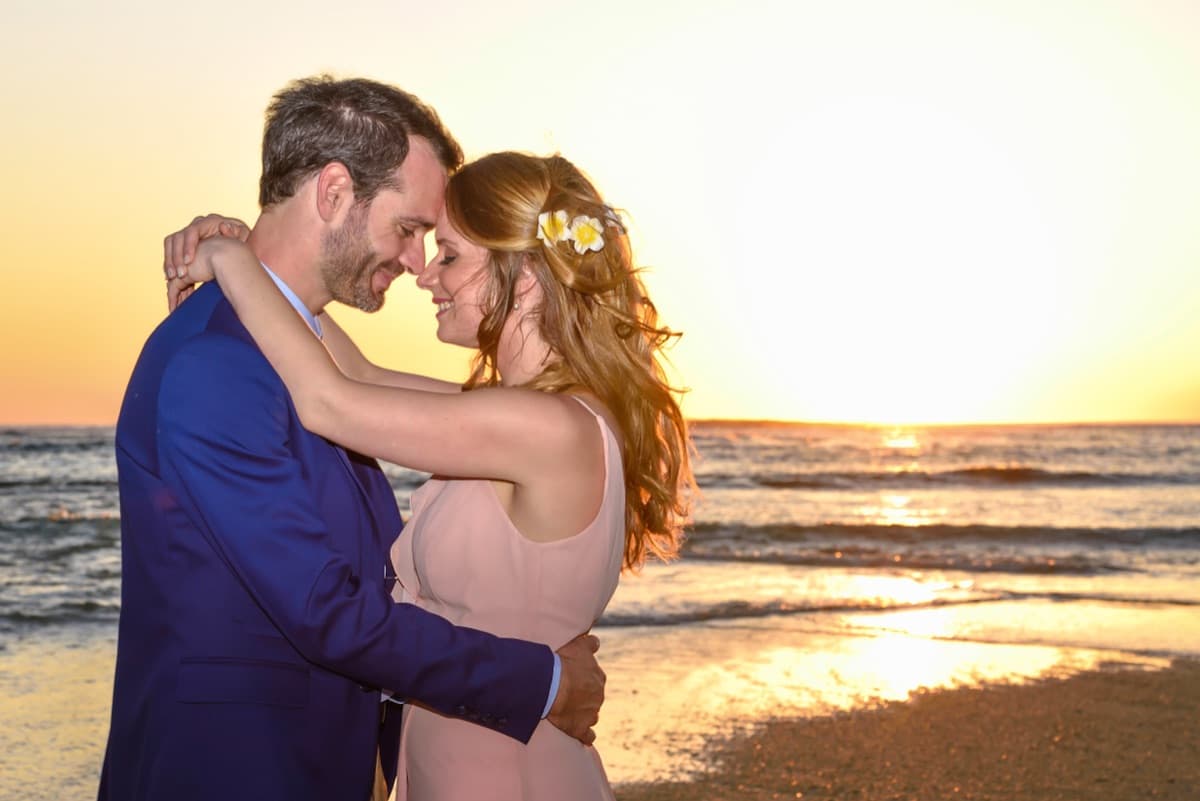
Because the day you are there, barefoot on the sand, with the civil registrar pronouncing the words that change a life, with the ocean murmuring behind you and the light of Mauritius gilding your face — that day, you will no longer think about the apostille. You will no longer think about the CCAM. You will no longer think about the transcription timeline.
You will think about the hand holding yours. The gaze that tells you everything. The word "yes" that, this time, will no longer be an administrative promise. It will be the beginning of everything.
Nat & Jude have been photographing weddings in Mauritius for over sixteen years. If you are planning your wedding on the island, contact us — we love stories that start with "what if we did this differently?"
Related Services
Honeymoon Photo Session
Immortalize your honeymoon with a romantic photo session on the most beautiful beaches of Mauritius
Wedding Photography
Capture every precious moment of your wedding with our expertise of over 16 years
Couple Photo Session
A romantic photo session to celebrate your love in paradisiacal settings